
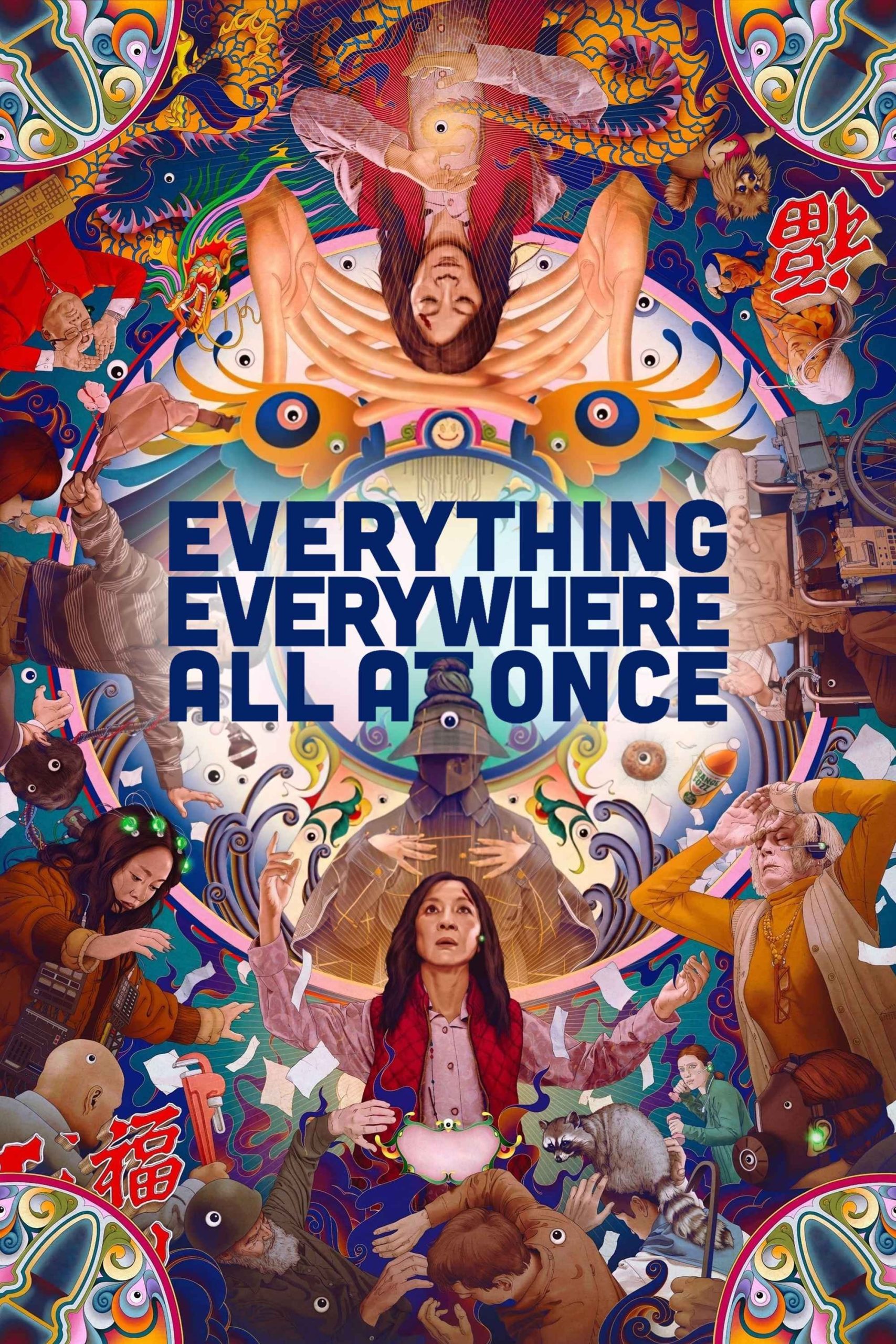
Overall Critical Reception
For me, “Everything Everywhere All At Once” arrived in a cinematic landscape hungry for invention, and the way critics reacted was unlike anything I’d seen in years. Even at the moment of release, I remember a rush of near-euphoric responses, with many seasoned reviewers describing it as a jolt to the system—a galvanizing reminder of what movies could be when they’re allowed to take radical risks. I found most outlets amplifying their astonishment at the film’s audacity. Rather than a slow burn of word-of-mouth, the critical noise was immediate, building quickly into a near-unanimous praise fest. But what I found most memorable was how critics contextualized their excitement within the broader scope of genre-bending films; several reviewers drew direct comparisons to earlier works that had redefined cinematic language, yet they often concluded that “Everything Everywhere All At Once” was in a league of its own in terms of maximalist filmmaking. It felt as though the majority reveled in the film’s agility, not just as a sci-fi action comedy, but as a dense, restless experiment that kept surprising them at every turn. Even critics known for a curmudgeonly approach seemed defenseless against its overwhelming energy, frequently singling out its unpredictable momentum and blend of influences as invigorating.
Within the first waves of reviews, I remember seeing essay-length pieces that traced how directors Daniels (Daniel Kwan and Daniel Scheinert) had matured from their absurdist roots without flattening their wild chaos. The film was lionized for shifting and converging genres—action, fantasy, comedy, and interpersonal drama—with a level of technical finesse that I rarely see united under one roof. In the months and years following the premiere, the film’s reputation among critics didn’t just persist, it appeared to solidify. Many retrospectives and roundups highlighted it as not merely a highlight of 2022 but a pivotal entry in 21st-century filmmaking. I noticed that, during awards season, critical support didn’t dissipate; instead, it grew only more vocal, especially as the film swept guild and association awards. The critical consensus settled into one of enduring admiration, and while a handful of reputable voices continued to raise doubts about its tonal excesses, the majority treated these objections as the cost of genuine ambition rather than outright flaws.
Over time, critical writings about the film have developed a sort of shorthand: it’s often cited as a rebuke to formulaic blockbusters and a triumphant flag-bearer for indie artistry breaking through mainstream barriers. Even as some later reviews have tried to create space for a more measured analysis, I haven’t seen a significant downturn in esteem. For many critics I respect, it remains a touchstone for discussions about innovation, representation, and the future direction of genre cinema.
Major Film Rating Platforms
- IMDb – Explain what the general score range and voting patterns indicate.
- Rotten Tomatoes – Explain the difference between critic consensus and audience response.
- Metacritic – Explain how aggregated reviews reflect critical opinion.
My experience checking IMDb for this movie’s trajectory was almost as chaotic as the film itself. The score, which floated well above what I expect for most genre comedies, suggested broad appeal without dilution. When I first encountered the rating, my impression was that this wasn’t just the result of a loud minority—or a fleeting trend. Patterns over time pointed to a consistently high average, with tens of thousands, then hundreds of thousands, of votes rolling in from all over the world. There’s often a cliff where a movie with significant hype (or divisive style) starts to lose ground with the masses, but here, the votes seemed to stabilize, buoyed by both longtime film lovers and casual moviegoers. I noticed that demographic breakdowns indicated high marks from younger audiences, but there wasn’t a steep drop-off among older viewers either, which is rare for something this kinetic and unconventional. The score range held strong against the weight of contrarians, rarely sinking even as the numbers of votes multiplied, reflecting genuine cross-generational enthusiasm rather than an insular fan surge or fleeting meme status.
The Tomatoes platform is always a revealing litmus test for whether critics and audiences are moving in lockstep, and in this case, I found both metrics veering toward the upper echelons. Critics flocked to the “Certified Fresh” designation with overwhelming swiftness, resulting in a critical consensus that stamped the film as one of the year’s best almost overnight. But when I drilled into the audience score, what stood out to me was the slightly wider spread of experiences—still overwhelmingly positive, yet with a bit more visible polarization than among the professional reviewers. Based on the platform’s user feedback, it became clear that most non-critics also latched onto the film’s energy and inventiveness, though a not insignificant minority cited issues with pacing or narrative coherence. This difference told me that while critics were swept up in the sheer bravura of the execution, some viewers found the relentless style exhausting. Even so, these lower audience ratings were far outweighed by glowing endorsements, and the “audience liked it” metric maintained a robust figure, signifying a rare convergence between institutional approbation and widespread popular embrace. For me, the slight gap in scores only reinforced how challenging works—even crowd-pleasers—invite passionate, sometimes divided, opinions when they avoid easy formulas.
With Metacritic’s calculation methodology, I always look for the spread—the aggregation often brings the more measured voices into sharper relief. On this site, I observed a notably high metascore, built out of consistently positive reviews from both mainstream publications and niche outlets. The platform’s color-coded system left little doubt about the film’s critical fortune; the green bar signified not just a momentary burst but sustained consensus. If there was any red or yellow shading at all, it came from outlier critics who generously articulated their reservations about excess or repetition, but the vast majority of scores seemed to coalesce well above average. What I found particularly telling was the consistency across international critics, not just US or English-language reviewers. There were very few cases of regionally divergent ratings, suggesting to me that the film’s impact was truly global—a rare feat for something so culturally and linguistically specific. Metacritic’s aggregation, with its synthesized score and fade-resistant positivity, gave me the sense of a nearly unified critical front, and the site’s detailed breakdowns allowed me to track how early enthusiasm seamlessly transitioned to year-end “best-of” lists.
Audience Response and Popular Opinion
My own immersion in online and in-person discussions left me with the impression that “Everything Everywhere All At Once” managed to bridge one of the most formidable divides: it found real affection from mainstream audiences while still courting a fervent, almost evangelical, kind of fanbase. I vividly recall talking to friends and overhearing strangers recounting their immediate post-viewing experiences—there was a contagious energy, a kind of shellshock, as people tried to put their reactions into words. Unlike many acclaimed indies that never quite cross into mass consciousness, this film seemed to break out of cinephile circles and establish a viral cultural footprint. Social media feeds were saturated with memes, elaborate fan theories, and teary testimonials from viewers who said they’d never seen anything like it. To my eyes, the film’s sheer emotional velocity was the engine behind its word-of-mouth success. I lost count of the times I saw people, even those who aren’t regular moviegoers, express gratitude that “something so weird” had made it to their screens—and resonated so deeply.
Yet, from my perspective, the reaction wasn’t uniformly euphoric. There was a small but persistent thread of confusion or fatigue, mostly from those for whom the film’s relentless pace or maximalist style proved overwhelming. Among casual viewers, I detected some pushback against the constant barrage of visual and narrative ideas, which for these folks, sometimes crossed the line from exhilarating to exhausting. Still, these responses were, in my experience, heavily outweighed by genuine excitement; for once, I saw online chatter dominated not by spoiler warnings or debate, but by sheer, delighted astonishment. The film’s reputation for “must-see” status felt, to me, broadly organic—built less on marketing and more on the relentless momentum of personal recommendations, repeat viewings, and people eager to share a singular experience. From multiplexes to independent theaters to at-home viewing parties, I found that the film consistently inspired animated reactions, enthusiastic rewatches, and a level of sustained conversation rarely afforded even to other A24 releases with substantial critical virtue.
Points of Praise
- Versatility and Inventiveness – I have rarely seen a film so celebrated for its ability to leap effortlessly between genres, visual styles, and tones; the inventiveness drew widespread admiration. The industry buzz I encountered routinely pointed to sequences that seemed impossible on paper but worked spectacularly—everything from martial arts set-pieces to surreal alternate realities was brought together with a playful boldness that critics, myself included, considered a marvel of creative risk-taking.
- Performance Ensemble – To me, the cast’s work was a lightning rod for accolades. Michelle Yeoh’s lead performance, which critics nearly universally ranked as among her career best, anchored the film’s flights of fancy with lived-in emotion. I noticed equal respect for supporting cast members, especially Ke Huy Quan’s heartfelt return and Stephanie Hsu’s dynamic range, with critics constantly referencing the natural chemistry and the actors’ capacity to switch registers on a dime. The performances formed a beating heart amid the narrative chaos, and this ensemble affirmation appeared again and again in reviews and public commentaries alike.
- Technical Mastery – My analysis of critical and industry chatter revealed special attention paid to the film’s technical achievements. Editing was singled out for praise, often described as “dazzling” or “seamless,” despite the sheer complexity of the plotting. Costuming and production design routinely surfaced in discussions as elements that tied the multiverse conceit into tangible reality. Much of the applause from professionals centered on the film’s ability to balance practical effects with economic digital wizardry, setting new benchmarks for visual storytelling on an indie budget.
Points of Criticism
- Narrative Density – From my vantage point, even some of the staunchest admirers pointed out that the relentless onslaught of ideas and subplots occasionally resulted in a sense of bloat. The critical minority, whose voices I tracked across forums and print reviews, worried that the barrage of new timelines, concepts, and emotional pivots risked turning novelty into fatigue for certain viewers. I also saw some common audience critiques focusing intensely on narrative excess as a hurdle to full engagement.
- Tonality and Pacing – In the debate I witnessed among aficionados and casual fans, the film’s extreme shifts in tone—oscillating from earnest drama to slapstick absurdity within moments—led to comments about tonal whiplash. A segment of viewers described feeling overwhelmed by how quickly the film leapt from scene to scene, while a few critics expressed that the frantic pacing, especially in the film’s latter halves, made it difficult to form a sustained emotional connection.
- Accessibility – If there was a primary dividing line I noticed between diehard fans and those less moved, it fell along questions of accessibility. Some critics, along with parts of the general audience, expressed concern that the barrage of references, rapid-fire editing, and deeply referential humor left viewers behind if they couldn’t immediately track with the movie’s visual or narrative logic. This critique didn’t dominate, but it persisted enough in reviews and comment sections for me to consider it a meaningful counterweight to the overwhelming praise.
How Reception Has Changed Over Time
Reflecting on the film’s journey since its debut, I’ve seen its reputation become almost mythic within certain circles while also attaining bona fide mainstream credibility. Instead of experiencing the backlash or “correction” that often follows a hyped release, “Everything Everywhere All At Once” appears to have weathered the post-awards scrutiny with remarkable stability. In my ongoing review of critical and fan discussions, most sentiments grew only more gushing after its Oscar wins; among cinephiles, the film held up to repeat viewing and further analysis, with its fine-grain details and easter eggs continually rediscovered. I tracked repeated references in best-of-the-decade polls, and noticed that, even among skeptics, the film rarely appeared on “most overrated” lists—a rare feat for any pop cultural phenomenon.
Where I have detected a shift, it’s mostly in the addition of new layers of appreciation. Early on, critics and the public alike seemed swept away by its immediacy and energy, but with distance, conversations now incorporate its influence on industry trends, its benchmark-setting for representation, and its behind-the-scenes creative ingenuity. Some dissenting voices have grown more pronounced, particularly among those who find the maximalist style wearing on repeat visits, but these are still far eclipsed by those who continue to see the film as a landmark. In aggregate, I would summarize the trajectory as one of unusual endurance and expanding reputation, with the excitement of the initial release translating into lasting cultural value. For me, the most telling measure is how much this film is now treated not as a curiosity, but as an enduring blueprint for what modern, globally-savvy, emotionally ambitious cinema can accomplish.
To go beyond scores and understand what shaped these reactions, background and interpretation can help.
🎬 Check out today's best-selling movies on Amazon!
View Deals on Amazon